Bear Power in Trading: Complete Guide to Using the Oscillator
Bear Power is an oscillator developed by Alexander Elder to measure selling pressure in the market. In this guide we will cover the calculation formula, signal interpretation, practical strategies, and combining with other indicators to improve trading efficiency.
1. Basic concepts: what is Bear Power?
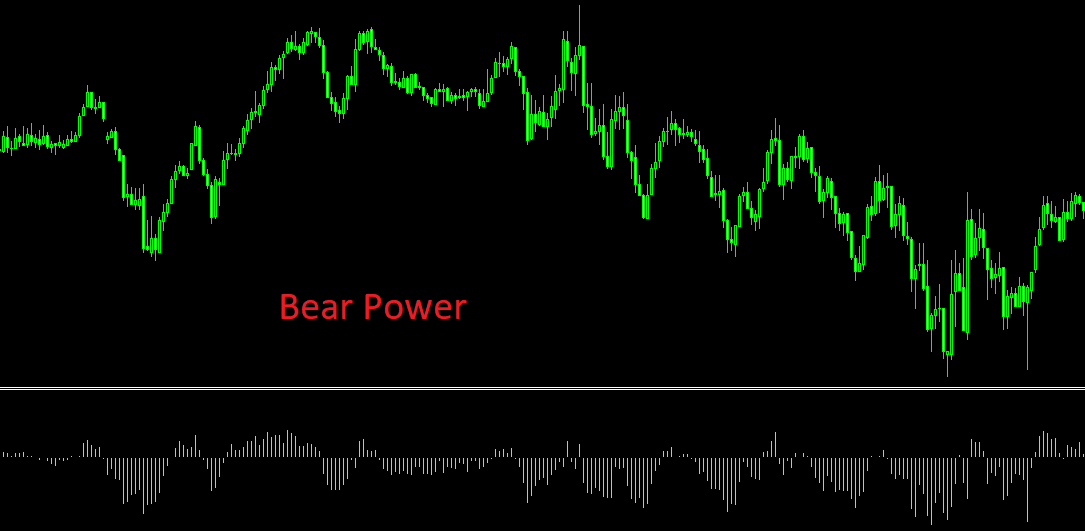
Bear Power is an oscillator that is part of the Elder's Force Index. It was developed by renowned trader and psychologist Alexander Elder, author of the bestseller “Trading for a Living”. Bear Power measures the ability of bears (sellers) to push price down. Unlike trend indicators that show direction, Bear Power focuses on the strength of selling pressure and helps identify when that pressure is weakening or strengthening.
Bear Power is often used together with its paired indicator Bull Power, which measures the strength of buyers. Together they give a complete picture of market sentiment. The indicator is especially useful for detecting divergences, finding reversal points, and assessing overbought/oversold conditions.
«Bears pull price down, bulls push it up. Bear Power shows how successful bears are at the moment. When their strength runs out, the market prepares for a reversal.»
2. Principle and calculation formula
Bear Power is calculated using a simple but effective formula:
where:
- Low — the lowest price of the current bar (candle);
- EMA(13) — exponential moving average with period 13, which serves as the “balance line” between bulls and bears.
The idea is that the 13-period EMA reflects the average price over recent time. If the current candle's low is below this average, bears are pushing price down — Bear Power is negative. If the low is above the EMA, bears are weak — the indicator is positive. The further the value from zero, the stronger the selling pressure (negative values) or the weaker the bears (positive values).
Important: Bear Power is not a standalone buy or sell signal. It must be used in the context of the trend and combined with other tools. For example, in an uptrend, negative Bear Power values may indicate a temporary weakening of bears and a good point to enter a long position.
3. Interpreting Bear Power values
Proper understanding of Bear Power signals is key to its effective use. Let us consider the main states of the indicator.
3.1. Negative values (bearish pressure)
A negative Bear Power indicates that the current candle's low is below the 13-period EMA. This is normal for a downtrend. However, it is important to track the dynamics: if negative values become deeper, bears are gaining strength. If negative values begin to shrink (become less negative), this may signal weakening selling pressure and a possible upward reversal.
3.2. Positive values (weakening bears)
Positive Bear Power occurs when the low is above EMA(13). In an uptrend this is normal. In a downtrend, the appearance of positive values may be an early sign of a trend change. The higher the positive value, the weaker the bears.
3.3. Extreme values and divergences
Like any oscillator, Bear Power can reach extreme levels. In a strong downtrend, the indicator can drop to -50, -100 or lower (depending on asset volatility). Such extremes often precede a correction or reversal. A particularly strong signal is a bullish divergence: price makes a new low, while Bear Power makes a higher low. This indicates weakening bearish strength and often foreshadows a rise.
4. Trading strategies with Bear Power
Bear Power can be used as a standalone filter, but best results are achieved when combined with trend indicators. Here are three proven strategies.
4.1. Buying on bear weakening
Conditions: Identify an uptrend (e.g., price above EMA(13) or above 200-period MA). Wait for Bear Power to move into negative territory (temporary strengthening of bears), then start turning up and cross the zero line from below. Entry point: when Bear Power crosses the zero line from below. Stop-loss: below the last local low. Target: previous high or 2-3 ATR.
4.2. Selling on positive values in a downtrend
Conditions: Downtrend (price below EMA(13) or below 200-period MA). Bear Power rises into positive territory (weakening bears), then turns down and crosses the zero line from above. Entry point: when it crosses the zero line from above. Stop-loss: above the last local high. Target: previous low or 2-3 ATR.
4.3. Divergences on Bear Power
Bullish divergence: price makes a new low, while Bear Power makes a higher low. This is a buy signal. Bearish divergence: price makes a new high, while Bear Power makes a lower high. Sell signal. Divergences on Bear Power are especially effective on higher timeframes (H4, D1, W1).
«Divergence between price and oscillator is like a warning from the market itself. Bear Power says: “Bears are running out of steam, get ready for a reversal”.»
5. Combining Bear Power with other indicators
Bear Power is rarely used alone. Here are the most effective combinations.
5.1. Bear Power + Bull Power (Elder's Force Index)
Bull Power = High − EMA(13). Together with Bear Power they show who dominates the market. When both indicators are positive, bulls control the market. Both negative — bears control. A divergence between them indicates a possible reversal.
5.2. Bear Power + moving averages
Use a long-term MA (e.g., 200) to determine the trend, and Bear Power to find entry points. In an uptrend (price above 200 MA), buy when Bear Power becomes negative and turns up. This gives more reliable signals.
5.3. Bear Power + RSI
RSI helps confirm overbought/oversold conditions. For example, if RSI is below 30 (oversold) and Bear Power is negative but starting to rise — buy signal. If RSI is above 70 and Bear Power is positive but turning down — sell signal.
6. Limitations and drawbacks of Bear Power
Like any indicator, Bear Power is not perfect. Its main drawbacks:
- Lag. EMA(13) introduces delay, so signals may come late.
- False signals in sideways markets. In a flat market, Bear Power often gives frequent zero‑line crossings, leading to losing trades.
- Dependence on period choice. The standard period of 13 does not suit all assets and timeframes. For cryptocurrencies sometimes period 21 works better, for stocks — 9.
- Does not show trend direction. Bear Power only measures bear strength, not where price is going. Therefore it must be combined with trend indicators.
To minimise false signals, always check the higher timeframe and use filters (e.g., volume or ADX).
Practical tips for using Bear Power
- Adjust the EMA period to your style. For scalping use 5-8, for swing trading 13-21, for long-term 34-50.
- Use Bear Power on multiple timeframes. A signal on H1 confirmed on H4 or D1 is much more reliable.
- Watch volume. If Bear Power turns and volume rises, the signal is strong.
- Do not ignore divergences. This is one of the strongest oscillator signals.
How technology enhances Bear Power analysis
Manual analysis of Bear Power on many charts takes time and attention. Services like AemmTrader automatically calculate Bear Power and Bull Power on all timeframes, and also look for divergences and reversal patterns. The platform provides ready‑made signals with success probability, which is especially useful for beginner traders.
The neural network analyses the indicator's history and predicts moments when bearish strength weakens. This allows entering trades at early stages of a reversal, when manual analysis does not yet give a clear signal. Combining Bear Power with machine learning gives you an objective assessment of the market situation.
Using such tools, you can focus on strategy rather than tedious calculations. This is the bridge between amateur and professional approaches — saving time and increasing efficiency.